

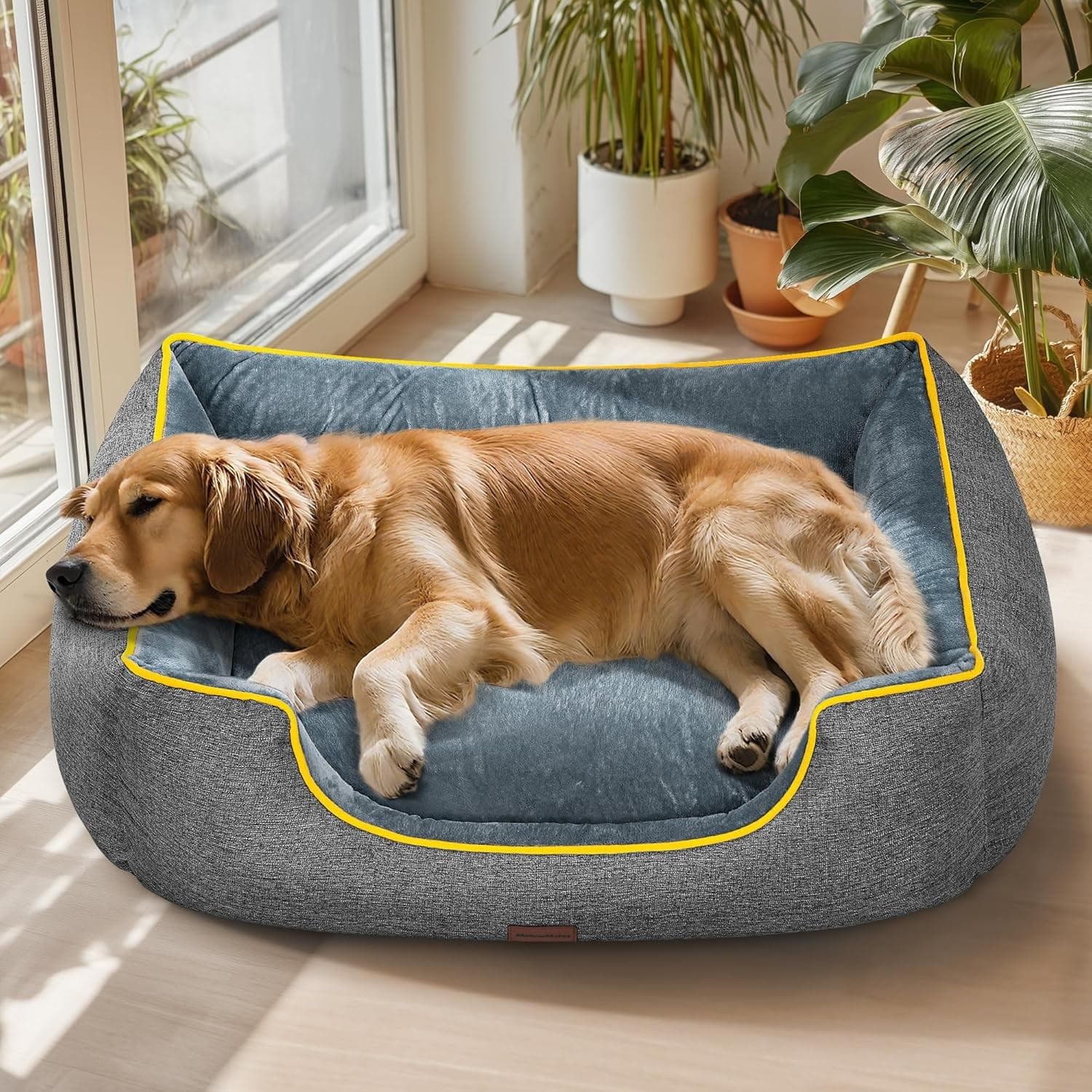
# Dog Bed Sizes in Canada: How to Measure Your Dog and Choose the Right Fit
Choosing a dog bed is not just about buying a small, medium, or large size. Two beds labelled “large” can have very different sleeping areas, and a bed that looks big from the outside may leave less room inside than expected.
If you are shopping for a dog bed in Canada, start with your dog's measurements rather than relying only on breed or weight. Check the usable sleeping area, consider how your dog sleeps, and compare the dimensions with the space available in your home.
This guide explains how to measure your dog, read a dog bed size chart, compare inches with centimetres, and choose a bed that suits your dog's everyday needs.
Quick Answer: What Size Dog Bed Do You Need?
Choose a bed that gives your dog enough room to lie down naturally without their head, legs, or body hanging over the edges. Measure your dog in their usual sleeping position and compare that measurement with the bed's internal sleeping dimensions.
As a starting point, use this approximate chart:
| Bed size | Approximate usable length | Suitable starting point |
|---|---|---|
| Extra small | 16–20 inches (41–51 cm) | Very small dogs |
| Small | 20–26 inches (51–66 cm) | Small dogs |
| Medium | 26–32 inches (66–81 cm) | Small-to-medium dogs |
| Large | 32–40 inches (81–102 cm) | Medium-to-large dogs |
| Extra large | 40–48 inches (102–122 cm) | Large dogs needing more room |
Important: These ranges are general shopping guidelines, not an official Canadian sizing standard. Manufacturers use different size labels, shapes, and measurements. Always check the product's dimensions before ordering.
How to Measure Your Dog for a Bed
You do not need special equipment. A flexible measuring tape, a little space, and a few minutes are enough.
1. Measure your dog's sleeping length
Watch how your dog usually sleeps. Some dogs curl into a ball, while others stretch out across the bed.
When your dog is lying in their normal sleeping position, measure from the tip of the nose to the base of the tail. For dogs that stretch out, also measure the full space occupied by their extended body, including their legs.
Write down the measurements in inches or centimetres. If you measure in centimetres, you can convert to inches by dividing by 2.54.
2. Measure the width they need
Observe how much space your dog uses when lying on their side. Measure across the widest part of their sleeping position, allowing room for their legs to rest naturally.
This measurement is especially useful if your dog sleeps stretched out or tends to move around during the night.
3. Consider your dog's sleeping habits
A dog that curls up may be comfortable in a round bed with raised edges. A dog that sleeps on their side or stretches out may need a longer rectangular mattress.
Do not choose a bed based only on the space your dog occupies while curled up if they regularly stretch out later.
4. Add room for natural movement
Your dog should be able to change position without constantly reaching the edges. If your dog is between two sizes, compare the internal dimensions of both options.
The larger size may be more practical if your dog stretches out, shares the bed with a favourite toy, or prefers extra space.
Dog Bed Size Chart: Inches and Centimetres
Use this expanded chart to compare common product dimensions when shopping online in Canada.
| Approximate internal length | Length in centimetres | What to consider |
|---|---|---|
| 16 inches | 41 cm | Very compact sleeping area |
| 20 inches | 51 cm | Small curled-up sleeping position |
| 24 inches | 61 cm | More room for many small dogs |
| 28 inches | 71 cm | A possible fit for some small-to-medium dogs |
| 32 inches | 81 cm | More room for dogs needing a longer surface |
| 36 inches | 91 cm | A larger sleeping area |
| 40 inches | 102 cm | Useful for many dogs needing extra length |
| 48 inches | 122 cm | A very large sleeping surface |
These are reference measurements, not guaranteed breed recommendations. Length alone does not tell you whether a bed is wide enough or whether its raised sides reduce the usable space.
For example, a bed measuring 36 inches from its outer edge to the opposite outer edge may offer a shorter internal sleeping area. Read the product specifications carefully.
Internal vs External Dog Bed Dimensions
This is one of the most useful details to check before buying a bed online.
External dimensions describe the bed's overall size, including its frame, bolsters, or raised edges. Internal dimensions describe the usable space inside the bed.
Consider a rectangular bolster bed listed as 36 × 28 inches externally. Its padded sides may reduce the available sleeping surface. If the seller does not list the internal dimensions, ask for them or look for a product diagram before purchasing.
A simple rule: compare your dog's sleeping measurements with the usable area, not just the outer dimensions.
For flat mattresses, the external and usable measurements may be closer. For round beds, donut beds, and beds with thick bolsters, the difference can be more noticeable.
How to Choose a Bed by Sleeping Style
Your dog's sleeping style can be just as important as its size.
Dogs that curl up
A round or oval bed may suit dogs that naturally curl into a ball. Raised edges can provide a comfortable place to rest the head, provided the sleeping area is still large enough.
Dogs that stretch out
Look for a rectangular mattress with enough length and width for your dog to stretch without hanging over the edges. Check the internal measurements before buying a bed with thick bolsters.
Dogs that rest their head on raised edges
A bolster bed may be a good option if your dog likes to use the edge as a headrest. Check both the sleeping area and the height of the sides.
Dogs that change positions frequently
Choose a bed with enough usable space for your dog to turn, stretch, and settle again. A bed that fits only one sleeping position may feel restrictive.
Does Dog Breed Determine Bed Size?
Breed can help you estimate where to start, but it should not determine your final purchase.
Dogs of the same breed can have different body lengths, builds, weights, and sleeping habits. A young dog and a fully grown dog of the same breed may also need different sizes.
Use breed information as a rough starting point, then check your individual dog's measurements against the manufacturer's dimensions.
Weight can help you check a bed's recommended weight capacity, but it does not tell you how much sleeping space your dog needs. A long, lean dog may need a different shape from a heavier dog of similar weight.
Choosing a Dog Bed for Canadian Homes
The best bed is one that fits your dog and works in your home.
Measure the space where the bed will go
Before ordering, measure the floor space in the area where your dog usually rests. Leave enough room for people to walk past without constantly moving the bed.
If the bed will sit in a crate, measure the crate's usable floor area and compare it with the mattress dimensions. Do not assume that a bed labelled for a particular dog size will fit your crate.
Think about entry and access
If your dog has difficulty stepping over high edges, consider a flatter mattress or a bed with a lower entrance. The design should allow your dog to get in and out comfortably.
Consider where the bed will be used
A bed for a living room may have different practical requirements from one used in a crate, bedroom, or travel setup. Check the product's cleaning instructions, cover design, and whether its shape fits the intended space.
If you plan to use the bed in more than one location, measure each space first.
Check washing and care instructions
Dog beds can collect fur, dirt, and everyday odours. Before purchasing, check whether the cover is removable, whether it can be machine-washed, and what cleaning instructions the manufacturer provides.
A washable cover can make regular cleaning easier, but confirm the instructions rather than assuming every removable cover is machine-safe.
Check delivery and returns
When ordering online in Canada, review the seller's delivery details, return window, and return shipping terms. A large dog bed can be inconvenient or expensive to return if it does not fit.
Keep the packaging until you have checked the size and confirmed that the bed suits your dog, subject to the seller's return conditions.
What Size Bed Should You Buy for a Puppy?
Puppies grow, so a bed that fits today may not provide enough room a few months later.
If you want a bed that lasts longer, check the expected adult size and compare the product dimensions with your puppy's current measurements. Leave enough room for comfortable movement without choosing a design that is difficult for the puppy to enter.
For a puppy still learning household routines, a washable cover can be helpful. Check the manufacturer's guidance on cleaning and durability, and inspect the bed regularly for damage.
Avoid assuming that every puppy needs the smallest available bed. The right choice depends on the puppy's current size, expected growth, and how the bed will be used.
What About Senior Dogs?
Older dogs may benefit from a bed that is easy to enter and offers suitable support. However, the right firmness and design depend on the individual dog's needs.
Consider a low-entry bed if stepping over raised edges is difficult. Look at the manufacturer's information about mattress materials, thickness, and cleaning requirements.
If your dog has ongoing joint pain, mobility problems, or a medical condition, ask your veterinarian for advice about suitable bedding. A larger bed alone does not guarantee better support.
Common Dog Bed Sizing Mistakes
Avoid these mistakes when comparing dog beds:
- Buying by breed alone: Individual dogs vary in length, build, and sleeping habits.
- Using weight as the only measurement: Weight does not indicate the exact sleeping space needed.
- Ignoring internal dimensions: Thick edges can reduce the usable area.
- Choosing a bed that fits only when the dog curls up: Your dog may stretch out while sleeping.
- Forgetting the available floor space: A bed can suit your dog but still be too large for its intended location.
- Assuming size labels are standard: Small, medium, large, and XL vary by manufacturer.
- Skipping the return policy: Check the seller's terms before ordering a bulky item.
Dog Bed Buying Checklist
Before placing your order, confirm the following:
- [ ] I measured my dog's usual sleeping position.
- [ ] I checked both length and width.
- [ ] I compared the internal sleeping area, not only the external dimensions.
- [ ] The bed allows room for natural movement.
- [ ] The bed fits the intended floor or crate space.
- [ ] I checked cleaning instructions and product details.
- [ ] I reviewed delivery and return conditions.
Frequently Asked Questions
What size dog bed do I need?
Measure your dog in their usual sleeping position and compare those measurements with the bed's internal sleeping area. Choose a bed that allows comfortable movement and check the manufacturer's size guidance.
Should I size up when buying a dog bed?
Sizing up can be helpful if your dog stretches out, sits between two sizes, or needs extra room to change positions. However, check the usable dimensions and the space available in your home before choosing a larger bed.
Are dog bed sizes standard in Canada?
No single size label guarantees the same dimensions across all brands. Always compare the measurements shown on the product page, including whether they refer to the internal or external size.
Are dog bed measurements shown in inches or centimetres in Canada?
You may see either inches or centimetres, depending on the retailer and manufacturer. Check the units before comparing products. To convert inches to centimetres, multiply by 2.54.
Is a larger dog bed always better?
Not necessarily. The bed needs to provide enough room for comfortable movement, but its shape, support, entry height, and intended location matter too. Choose a size that suits your dog rather than automatically buying the largest option.
How do I measure a dog bed before ordering online?
Check the product's length and width, then find out whether those are external or internal measurements. If the usable sleeping area is not listed, ask the seller for clarification before purchasing.
How often should I replace a dog bed?
There is no fixed replacement schedule for every dog bed. Inspect it regularly and consider replacing it when the filling becomes flattened, the structure is damaged, the surface is difficult to clean, or it no longer suits your dog's needs.
If you want to know how in uk dog bed know about him..
Final Thoughts
Choosing the right dog bed starts with your dog's measurements, not the size label on the packaging. Compare the usable sleeping area, consider how your dog rests, and check the bed's shape and intended location before buying.
For Canadian shoppers, comparing inches and centimetres can make it easier to evaluate products from different manufacturers. Take a few minutes to check the dimensions and return conditions before ordering. A well-sized bed should give your dog enough room to rest naturally while fitting comfortably into your home.