
# Best Dog Beds for Large Dogs: Support, Durability and Fit
Choosing a bed for a large dog is about more than finding an extra-large cushion. A Labrador that stretches out across the floor, a German Shepherd that prefers raised edges and a senior dog that needs easier access may all benefit from different bed designs. The best dog beds for large dogs should provide enough sleeping space, suitable cushioning and a construction that holds up to everyday use.
At Zarexon, we believe practical pet-care decisions should start with the dog's actual needs rather than a product's size label or marketing claims. This guide explains how to compare large-breed dog beds, evaluate foam and filling, choose between different designs and identify features worth paying for.
What Makes a Good Dog Bed for a Large Breed?
Large dogs need a bed that accommodates their body size and preferred sleeping position. However, a bigger mattress is not automatically a better mattress. The surface, materials, construction and ease of use all affect whether a bed is suitable for your dog.
Before comparing products, evaluate these five factors:
- Usable sleeping space: Your dog should be able to lie down naturally without hanging over the edge.
- Support: The mattress should provide suitable cushioning without compressing completely under your dog's weight.
- Construction: Examine the filling, seams, base and cover for signs of practical, everyday durability.
- Accessibility: Consider whether raised edges or a tall mattress make getting on and off difficult.
- Maintenance: Removable covers and clear cleaning instructions can make routine care easier.
A large-breed dog bed should balance these features rather than prioritizing appearance alone.
Which Type of Large Dog Bed Should You Choose?
Different bed styles solve different problems. Start with your dog's habits and the environment where the bed will be used.
| Dog bed style | May suit | What to consider |
|---|---|---|
| Flat mattress bed | Dogs that stretch out or change sleeping positions frequently | Usable surface area and mattress construction |
| Bolster or sofa-style bed | Dogs that like resting their head against a raised edge | Height of the sides and space remaining inside |
| Orthopedic-style foam bed | Owners looking for a more supportive sleeping surface | Foam quality, thickness and compression under weight |
| Pillow-style dog bed | Dogs that prefer a soft, flexible resting surface | Whether the filling stays evenly distributed |
| Elevated dog cot | Some dogs that benefit from airflow beneath the sleeping surface | Frame stability, fabric tension and ease of access |
| Washable-cover dog bed | Homes that need convenient routine cleaning | Cover removal, washing instructions and replacement options |
These categories are starting points, not guarantees of comfort or durability. The construction of an individual product matters more than the style name printed on its label.
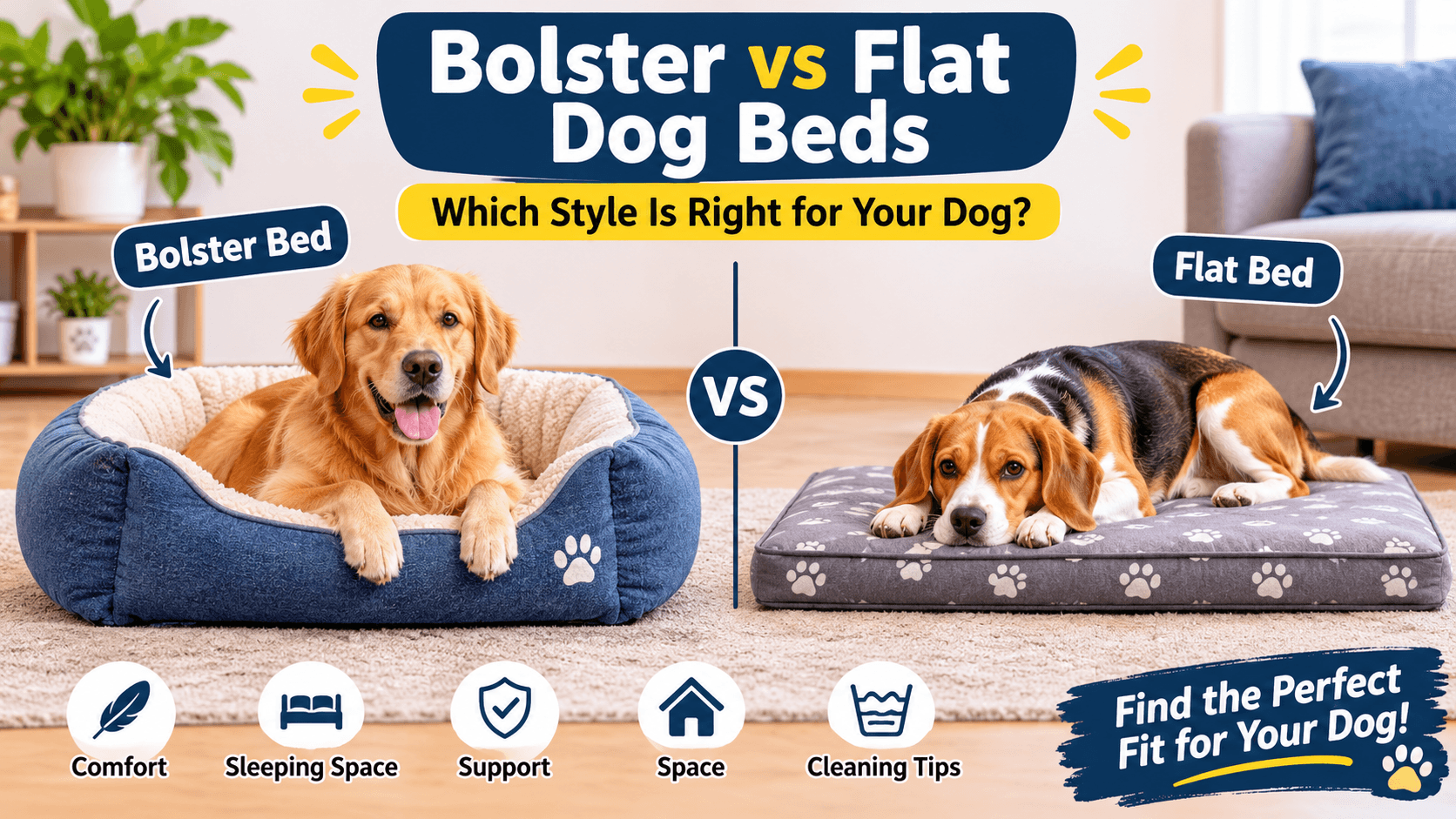
Flat mattress vs. bolster bed for large dogs
A flat mattress generally offers more uninterrupted sleeping space. This can be useful for dogs that stretch their legs or move around while settling down.
A bolster bed has raised sides that some dogs enjoy leaning against or resting their heads on. However, the bolsters reduce the usable sleeping area, even when the advertised external dimensions look generous.
Before buying either style, measure the area your dog will actually lie on. If your dog prefers sprawling, prioritize a wide, unobstructed surface. If your dog curls up against the edge, a bolster design may be worth considering.
Is an orthopedic dog bed better for a large dog?
An orthopedic-style dog bed is generally marketed around cushioning and support, often using foam or layered materials. Some designs may suit dogs that need a firmer or more substantial sleeping surface.
However, the word orthopedic alone does not prove that a bed provides a particular medical benefit. There is no single construction or thickness that automatically makes every dog bed suitable for every dog.
When comparing orthopedic dog beds for large dogs, check:
- The type of foam or filling used.
- The thickness of the complete mattress and its individual layers, if stated.
- Whether the mattress compresses substantially under your dog's weight.
- The dimensions of the usable sleeping area.
- The manufacturer's cleaning and care instructions.
If your dog has arthritis, persistent stiffness or mobility problems, ask your veterinarian about suitable bedding and other measures that may help.
How to Choose the Right Size: Large, XL or XXL?
Size labels are not standardized across all dog bed manufacturers. One brand's large bed may have different dimensions from another brand's extra-large model.
For this reason, compare measurements rather than relying exclusively on labels such as large, XL, XXL or giant breed.
Measure your dog before ordering
Use this simple method to estimate the sleeping space your dog needs.
Step 1: Observe your dog's sleeping position.
Notice whether your dog curls up, lies on their side or stretches out with their legs extended. The longest natural resting position is particularly useful when assessing mattress length.
Step 2: Measure body length.
When your dog is standing comfortably, measure from the nose to the base of the tail. You can also observe and measure the space occupied when your dog lies naturally stretched out.
Step 3: Check width.
Consider your dog's body width and the space occupied by their legs when lying down. A long but narrow mattress may not be comfortable for a broad or sprawling dog.
Step 4: Compare the actual sleeping surface.
Check whether the product lists external dimensions or the usable interior area. Raised sides and thick borders can make the actual sleeping space considerably smaller.
Step 5: Consider your dog's weight and the manufacturer's guidance.
Weight can help narrow down the options, but it should not be the only factor. Body length, build and sleeping style also matter.
For a more detailed explanation, read our dog bed size guide. It covers general sizing and measurement considerations, while this guide focuses on choosing a suitable bed for a large dog.
Buying tip: If your dog falls between two sizes, compare the usable dimensions of both options. Choosing the larger bed may be sensible if your dog stretches out, provided it fits your available space.
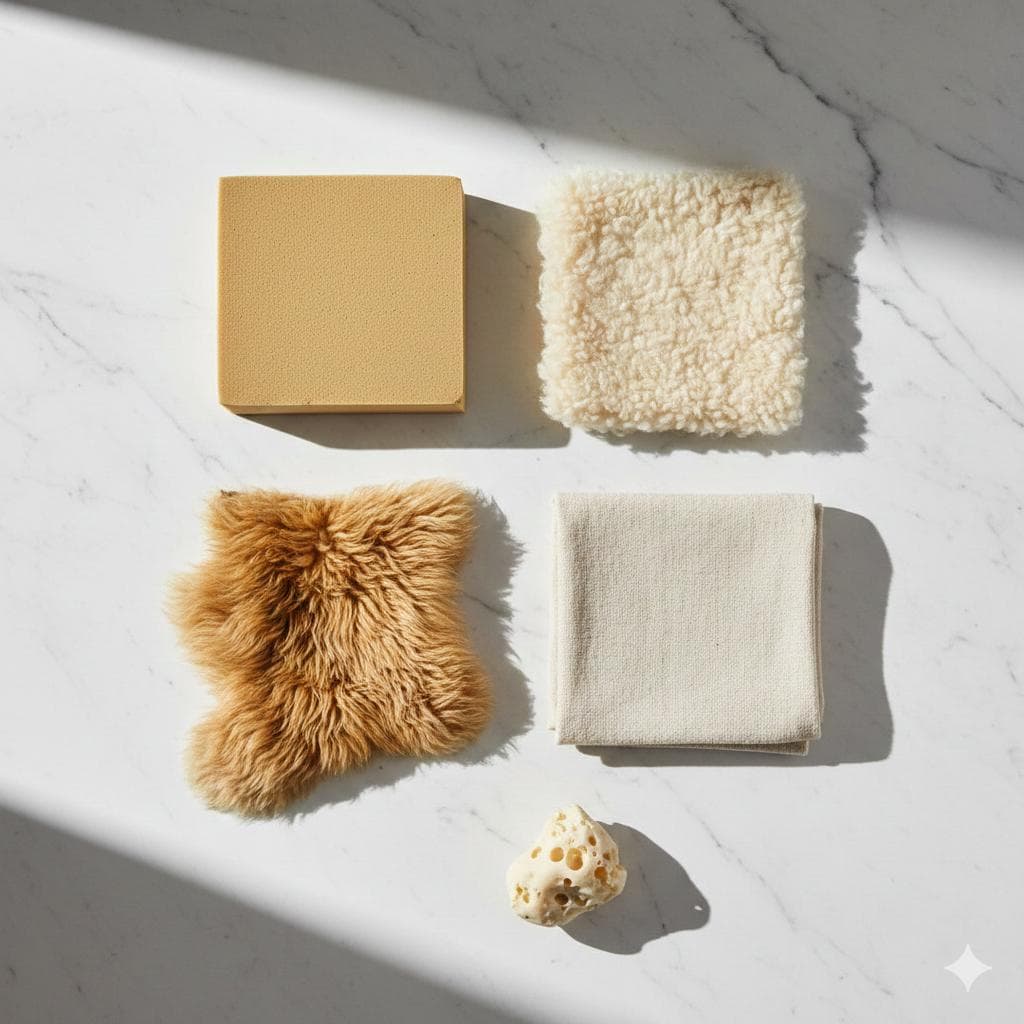
What Mattress Materials Work Well for Large Dogs?
The filling determines much of a dog bed's feel and how it responds to pressure. Two mattresses with similar dimensions can perform differently because they use different materials and constructions.
Memory foam
Memory foam is designed to respond to pressure and may contour around a dog's body. Its performance depends on the foam formulation, density, thickness and overall mattress construction.
Check the manufacturer's specifications instead of assuming that every memory foam bed offers the same level of support.
High-density foam
High-density foam is often used in mattresses intended to provide a more substantial base. However, density, firmness and durability are different properties. A product's label alone does not establish how it will perform under a particular dog's weight.
Look for clear material information and inspect the warranty terms if long-term use is a priority.
Layered foam
Some large dog beds use multiple layers with different properties. A softer top layer may feel different from a firmer base, but the number of layers alone does not prove that the mattress is better.
Consider the complete construction, usable thickness and the manufacturer's explanation of the materials.
Polyester and loose filling
Polyester fiberfill and similar loose fillings can create a soft, cushioned bed. Depending on the construction, the filling may shift or bunch together with use.
If you prefer a pillow-style dog bed, check whether the filling is evenly distributed and whether the cover can be opened for maintenance.
Egg-crate foam
Egg-crate foam has a shaped surface rather than a flat top. Some products use it as one layer of a mattress, but the shape alone does not establish how supportive or durable the bed will be.
The key takeaway: Compare actual material specifications, construction and care requirements instead of choosing a mattress based on a single label such as memory foam, orthopedic or high-density.
How Thick Should a Large Dog Bed Be?
There is no universal thickness that guarantees a suitable bed for every large dog. The right choice depends on the dog's weight, the materials used, the mattress construction and how much the surface compresses when the dog lies down.
A thick mattress made from unsuitable or easily compressed filling may provide less useful support than its dimensions suggest. Conversely, a carefully constructed mattress may perform differently despite having a lower overall profile.
When comparing mattress thickness:
- Check the stated thickness of the complete mattress.
- Look for details about the filling and any separate foam layers.
- Consider whether the product is designed for your dog's weight range.
- Check reviews for relevant information about long-term shape retention, while remembering that individual experiences vary.
- Assess whether the mattress remains comfortable and easy to use after regular wear.
Avoid treating a specific number of inches as a universal veterinary standard. Product construction and your dog's individual needs are more informative than thickness alone.
What Makes a Large Dog Bed Durable?
A bed used every day needs to withstand repeated lying down, getting up, scratching, shedding and routine cleaning. Durability depends on the complete product rather than just the outer fabric.
Check the cover fabric
Look for clear information about the fabric, its intended use and how it should be cleaned. A thicker fabric may be useful in some households, but thickness alone does not guarantee resistance to tears or abrasion.
Inspect seams and closures
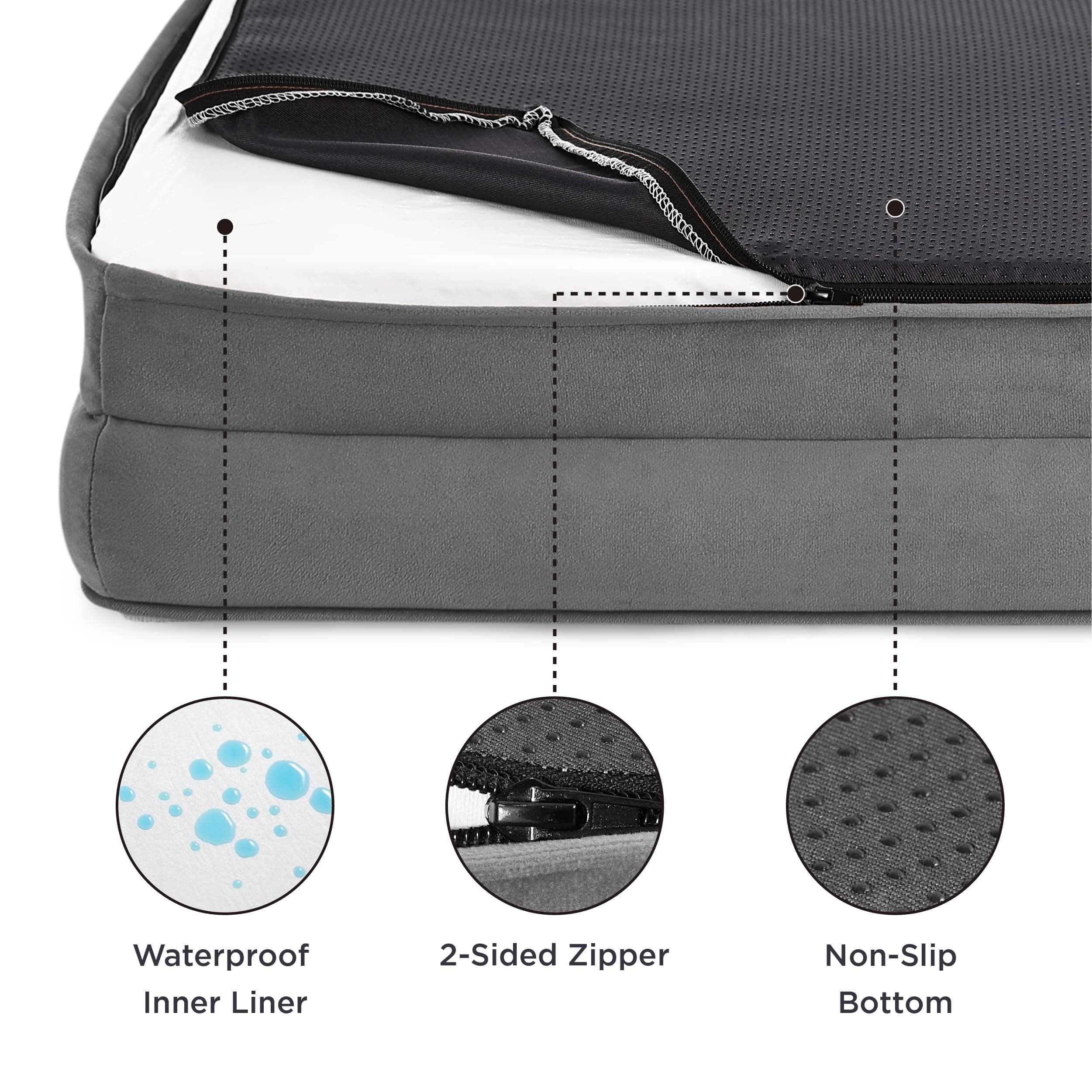
Seams, zippers and corners can experience repeated stress. Check product photographs and descriptions for information about construction and replacement covers.
Evaluate the mattress
The filling should suit the dog's size and the bed's intended use. If the manufacturer provides details about foam composition, support layers or warranty coverage, use those details to compare products.
Look at the base
A non-slip underside can help keep a bed in place on suitable flooring. Its effectiveness depends on the base material and the surface underneath it.
Read the warranty carefully
A warranty may cover certain manufacturing defects or changes in materials, but exclusions can apply. Check the duration, covered components and any conditions before treating a warranty as evidence of guaranteed performance.
If your dog regularly chews bedding, remember that durable fabric does not automatically make a bed chew-proof. Inspect it frequently and remove damaged items if exposed filling or loose components could create a hazard.
Should You Buy a Waterproof or Washable Large Dog Bed?
These features serve different purposes, and some products offer both.
A washable dog bed is designed to make cleaning easier, often through a removable cover. A waterproof dog bed or protective liner is intended to limit liquid penetration through the specified protective layer.
Before buying, check the exact product description:
- Is the cover machine-washable, or does it require spot cleaning?
- Can the mattress itself be washed?
- Is the protective layer waterproof or merely water-resistant?
- Are there special drying instructions?
- Can you buy a replacement cover if the original wears out?
A removable cover can be particularly convenient for large dogs because the bed may collect considerable hair and dirt. A waterproof liner may be useful in households dealing with occasional accidents, but it should not replace prompt cleaning.
Read our washable vs. waterproof dog beds guide for a fuller explanation of the differences.
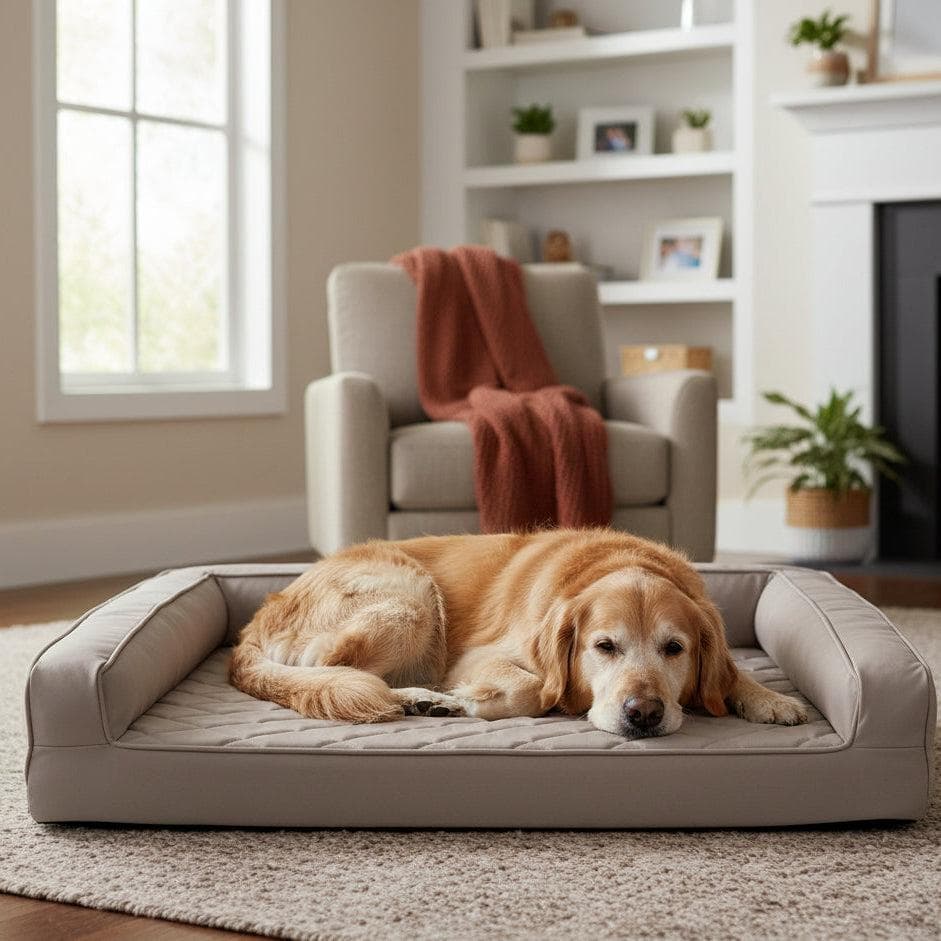
Choosing a Bed for a Large Senior Dog
An older dog may have different bedding needs from a younger adult dog. Some senior dogs continue to enjoy their usual bed, while others may need a different surface because of stiffness, reduced mobility or changes in sleeping habits.
Consider these practical features:
- Easy access: A lower entry may be easier to navigate than tall bolsters.
- Stable placement: A bed that slides across the floor can make getting on and off more difficult.
- Suitable cushioning: Consider how the mattress responds to your dog's body weight.
- Adequate space: Your dog should be able to lie down and change position comfortably.
- Simple maintenance: A removable cover may make cleaning more manageable.
Do not assume that every senior dog needs a particular type of foam or an especially thick mattress. If your dog struggles to stand, seems uncomfortable or has new mobility changes, consult a veterinarian rather than relying on a bed replacement alone.
What If Your Large Dog Sleeps on the Floor Instead?
Some dogs prefer cool, firm or familiar surfaces and may not immediately use a new bed. Buying a more expensive mattress does not guarantee that your dog will like it.
Before changing beds, observe where your dog naturally rests and how they position their body. Consider whether the current sleeping area is too warm, too enclosed, too soft or inconvenient to access.
Try placing the bed in a familiar, quiet location and allow your dog to investigate it voluntarily. Avoid forcing your dog to remain on the bed.
If your dog suddenly stops using a previously comfortable bed or appears reluctant to lie down, consider whether the bed's condition or your dog's comfort has changed.
A Practical Checklist Before Buying
Use this checklist to compare large dog beds without getting distracted by marketing language.
| What to check | Why it matters |
|---|---|
| Usable sleeping dimensions | Confirms the dog has enough room |
| Mattress materials | Helps you understand the bed's construction |
| Compression and firmness | Gives context about how the surface responds to weight |
| Cover care instructions | Helps you plan routine cleaning |
| Water protection | Clarifies whether the bed resists moisture or prevents liquid penetration |
| Base grip | Helps assess suitability for the intended floor |
| Entry height | Matters for dogs that have difficulty stepping over raised edges |
| Warranty details | Clarifies what the manufacturer agrees to cover |
| Replacement parts | May help extend the bed's useful life |
| Available product information | Makes it easier to compare products fairly |
If a product listing leaves important dimensions or material details unclear, contact the seller before purchasing.
Frequently Asked Questions About Large Dog Beds
What is the best dog bed for a large dog?
The best bed depends on the dog's body size, sleeping position, mobility and the mattress construction. Compare usable dimensions, cushioning, durability and cleaning requirements before choosing.
What size bed does a 90-pound dog need?
Weight alone cannot determine the correct bed size. Measure your dog's body and consider the space occupied when they lie down naturally. Then compare those measurements with the product's usable sleeping area and manufacturer sizing guidance.
Are orthopedic dog beds worth it for large breeds?
They may be worth considering if you want a mattress designed around cushioning and support. However, the term orthopedic does not guarantee a specific level of performance or a medical benefit. Evaluate the materials and construction, and ask a veterinarian about individual health concerns.
Is memory foam better than regular filling for large dogs?
Not automatically. Memory foam and loose filling have different properties, and their performance varies by construction. Compare the product specifications and consider your dog's preferences rather than assuming one material is always superior.
How can I tell whether a large dog bed will flatten?
No product description can guarantee how long a bed will retain its shape under every dog's weight and habits. Check the construction details, warranty, care instructions and relevant long-term owner feedback. Inspect the mattress periodically after purchase.
Is a bolster bed suitable for a large dog?
It can be, particularly if the dog likes resting against a raised edge. Check the usable sleeping area and the height of the sides. A flat mattress may be more suitable for a dog that prefers to stretch out fully.
Are washable covers important for large dog beds?
They can make routine cleaning more convenient, especially when a dog sheds heavily or spends time outdoors. Confirm whether the cover is removable and machine-washable, and follow the manufacturer's instructions.
Do large dogs need thicker beds than small dogs?
Not in every case. A larger or heavier dog may place different demands on a mattress, but suitable thickness depends on the material, construction and individual dog. Compare more than the number of inches.
How often should I replace a large dog bed?
Replace the bed when it becomes damaged, difficult to clean or no longer provides a suitable resting surface. The timing depends on materials, frequency of use and care, so a fixed lifespan should not be assumed for every bed.
Should I buy an XL or XXL dog bed?
Compare the actual dimensions instead of relying only on the label. Choose a bed that provides sufficient room for your dog's natural sleeping position and fits the space where you intend to place it.
Final Thoughts: Find the Right Bed for Your Large Dog
The best dog beds for large dogs combine suitable sleeping space, appropriate cushioning, practical construction and manageable care requirements. Start by measuring your dog, then compare the usable mattress dimensions, materials, cover and overall design.
A flat mattress may suit a dog that stretches out, while a bolster bed may appeal to one that likes resting against raised edges. An orthopedic-style mattress may be worth considering when support is a priority, but the product's actual construction matters more than its label.
At Zarexon, our goal is to help pet owners make informed choices with practical, straightforward guidance. Use the checklist in this article to compare your options and choose a bed that fits your dog's everyday needs.